The 90-Day Business Reset: A Step-by-Step Plan for Trade Business Owners
A practical framework to stop firefighting and start building a trade business that actually works.
I sat down with a Melbourne electrician last year who told me he’d had his “biggest revenue year ever.”
When I asked him to show me the numbers, it took him forty minutes to find them. They were scattered across three apps, a shoebox of receipts, and a spreadsheet his bookkeeper updated quarterly. When we finally pieced it together, his business had made $1.2 million in revenue—and $38,000 in profit. After paying himself a salary, he’d have been better off working for someone else.
That’s not a revenue problem. That’s a structure problem. And it’s the kind of thing that doesn’t get fixed by working harder, hiring another tradie, or running more Google Ads.
It gets fixed by stopping, auditing what’s actually happening in the business, and building a clear plan to restructure it over the next 90 days.
That’s exactly what we do at Scale360 in our first coaching session. And in this post, I’m going to walk you through the framework—step by step—so you can do a version of it yourself.
If you can’t explain how your business makes money in two sentences, you don’t have a strategy. You have a habit. |
Why 90 Days?
Because a year is too long and a week is too short.
Twelve-month business plans are where ambition goes to die. They’re too abstract, too far away, and too easy to shelve when the next emergency hits. On the other hand, weekly to-do lists keep you busy without ever moving the needle on the structural stuff that actually matters.
Ninety days is the sweet spot. It’s long enough to make meaningful operational changes—restructure your pricing, build a hiring system, fix your lead generation—but short enough that every single week counts. You can see the finish line. You feel the urgency.
The best-run trade businesses I’ve worked with don’t think in years. They think in 90-day sprints. Do the work. Measure the result. Reset. Repeat.
💡 Gold Nugget 90-day planning works because it creates urgency without overwhelm. You can’t procrastinate on a 90-day deadline the way you can on a 12-month one. Every week represents roughly 7% of your total runway—miss two and you’re already behind. |
Phase 1: The Audit (Week 1)
Before you plan anything, you need to know where you actually stand. Not where you think you stand. Not where your accountant told you six months ago. Where you stand right now.
This is the part most business owners skip—and it’s the part that matters most. You can’t build a plan on assumptions. You need facts.
1. Financial Health Check
Pull your numbers for the last 12 months. Not your tax return—your actual management numbers. You’re looking for five things:
Revenue by month — Is it growing, flat, or declining? Are there seasonal patterns?
Gross profit margin by service type — Which jobs actually make you money and which ones just keep you busy?
Overhead costs as a percentage of revenue — What’s your break-even point before you earn a dollar of profit?
Owner’s effective hourly rate — Take your total pay (including dividends) and divide by total hours worked. This number will either motivate you or horrify you.
Cash flow timing — When does money come in versus when it goes out? Are you funding jobs out of pocket for weeks before getting paid?
💡 Gold Nugget Your accountant’s job is compliance—making sure the ATO is happy. Your job is management accounting—understanding whether the business is actually healthy. These are two completely different things. If the only time you look at your numbers is tax time, you’re flying blind. |
2. Operations Audit
Walk through your business as if you were a new employee starting on Monday. Ask yourself:
Is there a documented process for quoting jobs, or does it live in your head?
Could someone else schedule your team tomorrow without calling you?
Do you have a written onboarding process for new staff?
Is your job management software actually being used properly, or is it half-set-up and mostly ignored?
What happens when something goes wrong on a job site and you’re not there?
If the answer to most of these is “it depends on me,” you’ve just identified your biggest constraint. The business can’t grow past your personal capacity until these systems exist outside your head.
3. Digital Presence Audit
Open an incognito browser window and Google what your ideal customer would search. “Electrician Melbourne south east.” “Commercial cleaner near me.” Whatever it is for your trade.
Do you appear in the top results? In the map pack?
Is your Google Business Profile fully completed with photos, services, and recent reviews?
Does your website clearly explain what you do, who you serve, and how to contact you?
When was the last time you posted anything online—website, social media, or Google?
Are you generating any inbound leads from your digital presence, or is everything word-of-mouth?
4. Team and Leadership Audit
This one’s uncomfortable. But it matters.
Do your staff know exactly what’s expected of them—written down, not just verbal?
When was the last time you had a structured performance conversation (not a reactive one after something went wrong)?
Is anyone on your team costing you more than they’re generating?
Are you spending more time managing your team than leading your business?
If you took two weeks off tomorrow, would your team know what to do?
The audit isn’t about finding everything that’s wrong. It’s about finding the three or four things that—if you fixed them—would change the trajectory of the business. |
Phase 2: The Plan (Week 2)
You’ve got your audit. Now you need to prioritise ruthlessly.
Here’s the mistake most business owners make: they try to fix everything at once. New pricing. New systems. New marketing. New team structure. All in the same month. It doesn’t work. You end up overwhelmed, nothing gets finished properly, and three months later you’re back where you started.
Instead, use the 3-3-3 framework.
The 3-3-3 Prioritisation Framework
Top 3 fires: What’s actively costing you money, time, or sanity right now? These get fixed in Month 1. They’re the bleeding wounds. Examples: underpriced jobs, a team member who’s not performing, invoicing delays causing cash flow crunches.
Top 3 foundations: What’s missing that would make the biggest structural difference? These are your Month 2 priorities. Examples: a documented quoting process, a Google Business Profile that’s actually optimised, a weekly financial review rhythm.
Top 3 growth moves: What would accelerate the business once the foundations are in place? These are Month 3. Examples: launching a local SEO campaign, building a referral system, implementing a staff KPI framework.
💡 Gold Nugget The 3-3-3 framework works because it forces sequencing. Fires first, foundations second, growth third. Most tradies jump straight to growth (more leads, more marketing) without fixing the operational leaks that mean those new leads just create more chaos. Fix the bucket before you pour more water in. |
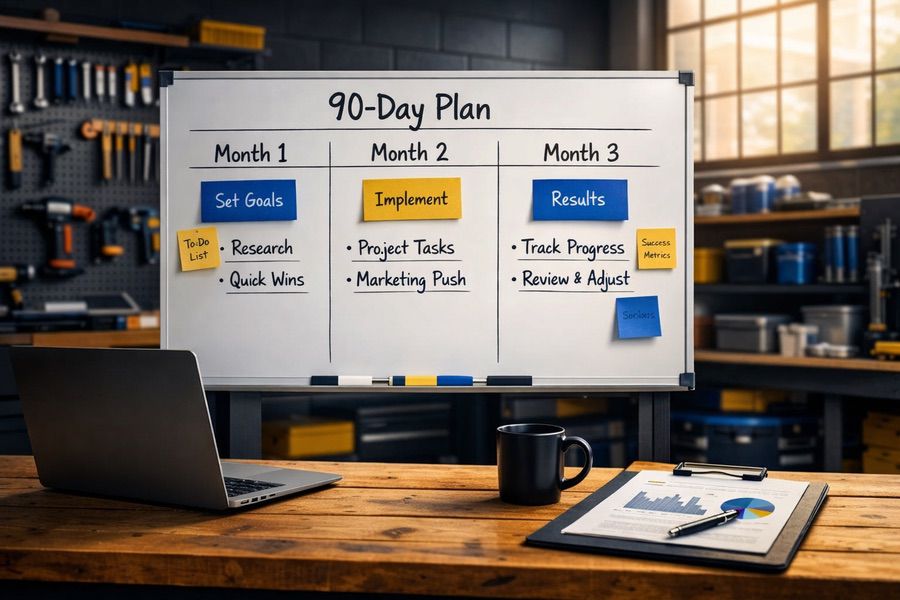
Build Your 90-Day Action Map
Take your nine priorities and map them across three months. For each one, define:
The specific outcome (not a vague goal—a measurable result)
The owner (who’s responsible, even if it’s you)
The deadline (a specific week, not “sometime in Month 2”)
The first action (what’s the very next physical step to get started?)
Write this down. Print it out. Stick it on the wall in your office or on the dashboard of your van. It needs to be visible, not buried in a Google Doc you’ll forget about by Thursday.
Phase 3: Execution (Weeks 3–12)
Month 1: Put Out the Fires
This is where discipline matters. Month 1 is about stopping the bleeding and creating breathing room.
If your pricing is wrong, fix it this month. Not next quarter. This month. Run the numbers on your top ten jobs from the last six months. Work out the actual margin on each one. If you’re under 30% gross margin on service work, your pricing is broken and no amount of marketing will save you.
If you’ve got a team member who’s not performing, have the conversation. Set clear expectations, document them, and give them a fair timeline. If they don’t improve, you already know what needs to happen. Carrying underperformers costs you more than just their wage—it costs morale, client experience, and your own time.
If your cash flow is unpredictable, build a simple weekly cash flow tracker. Every Friday, spend 15 minutes reviewing what’s in, what’s out, and what’s committed for the next fortnight. This one habit alone transforms financial decision-making for most trade business owners.
💡 Gold Nugget The 15-Minute Friday Review: Every Friday before you knock off, review three numbers—cash in the bank, outstanding invoices, and committed expenses for the next two weeks. It takes 15 minutes. It replaces the constant low-grade anxiety of not knowing where you stand. Build this habit in Month 1 and never stop. |
Month 2: Build the Foundations
With the fires handled, Month 2 is about installing the structural pieces that let the business operate more independently.
Pick one core process—quoting, scheduling, or job handover—and document it properly. Not a 40-page manual. A one-page standard operating procedure that any competent person could follow. Test it with your team. Refine it. Then move to the next one.
Get your Google Business Profile fully built out. Every service listed. Professional photos of completed work. A system for requesting reviews from satisfied clients. This is free marketing that works around the clock, and most tradies have either never set it up or abandoned it after the first week.
Introduce a structured team check-in. A 15-minute Monday morning standup where everyone knows what’s happening this week, who’s where, and what the priorities are. It sounds basic, but the number of trade businesses operating on guesswork and group texts is staggering.
Systems don’t have to be sophisticated to be effective. A one-page process that gets followed beats a fifty-page manual that sits in a drawer. |
Month 3: Make Growth Moves
By Month 3, your fires are out, your foundations are in place, and you’ve got some breathing room. Now you can focus on growth—without it creating more chaos.
This is where you invest in the things that compound over time. A local SEO strategy that builds month over month. A referral incentive for existing clients. A staff performance framework with clear KPIs so your team improves without you micromanaging every task.
This is also the month to step back and look at your business model. Are you chasing every type of work, or are you concentrating on the jobs that are most profitable? Are you quoting for clients you don’t even want? Are there entire service lines that lose money but you keep running out of habit?
Growth isn’t just about more revenue. It’s about better revenue—higher margins, better clients, more predictable work.
💡 Gold Nugget The most profitable trade businesses I’ve worked with don’t say yes to everything. They have a clear picture of their ideal job—type of work, minimum job value, geographic area, client profile—and they build their entire marketing and sales process around attracting more of that. Saying no to bad-fit work is one of the fastest paths to higher profit. |
The Weekly Rhythm That Holds It All Together
A 90-day plan is useless without weekly accountability. Here’s the rhythm I recommend to every business owner I coach:
Monday morning (15 mins): Review your 90-day plan. What’s the one thing that must move forward this week? Write it down.
Wednesday midweek (10 mins): Quick check. Are you on track? Has anything derailed you? Adjust if needed.
Friday close-out (15 mins): Financial review (cash, invoices, commitments). Plus: what got done this week, what didn’t, and why? Write it down. One sentence is enough.
Forty minutes a week. That’s it. But those forty minutes are the difference between a plan that gets executed and a plan that gets forgotten.
The business owners who win aren’t the ones with the best plans. They’re the ones who review, adjust, and execute every single week. Consistency beats intensity. |
What Happens at Day 90
Here’s what I’ve seen happen with clients who actually commit to this framework:
They understand their numbers for the first time—not just revenue, but actual profitability by job, by service line, and by client.
They’ve built at least two or three core operating procedures that let their team function without constant owner input.
Their digital presence is working for them—leads are coming in that they didn’t have to chase.
They’ve had the hard conversations about pricing, team performance, or business model that they’d been avoiding for months (or years).
They’re working fewer hours, making more money, and feeling less stressed—because the business has structure instead of chaos.
Not every business hits all of those in 90 days. But every business that does the work hits at least three of them. And the compounding effect from there is significant.
Start Your 90-Day Reset Today
You don’t need permission to do this. You don’t need a coach. You don’t need to wait until things are “quieter.” (They won’t be.)
Block two hours this week. Sit down somewhere that isn’t your work van or your job site. Bring your numbers, your laptop, and an honest assessment of where your business actually stands. Walk through the audit. Build your 3-3-3 priorities. Map out your 90-day plan. Start executing on Monday.
If you get stuck, or you want someone experienced to pressure-test your plan and hold you accountable to it, that’s exactly what Scale360 is built for.
Ready to Build Your 90-Day Plan? Book a free 30-minute discovery call. We’ll talk through your business, audit the numbers together, and build a clear plan to move forward. ▶ BOOK YOUR FREE DISCOVERY CALL Free. No obligation. Available via Zoom — Australia-wide. |